
Date: 3/2/2009
A Brief Biography of Shaykh Nasirudden Al-Albani (r)
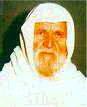
SHAYKH MUHAMMAD NASIRUDDEEN AL-ALBANI(R)- A brief Biography
He was born in the city of Ashkodera, then the capital of Albania in the year 1332H (1919 C.E.) into a poor family. His father al-Haaj Nooh Najjaatee al-Albani had completed Sharee'ah studies in Istanbul and returned a scholar to Albania. After Albania was taken over by atheism the family made Hijrah (migration) to Damascus. In Damascus Shaykh Nasiruddeen al-Albani completed his initial education and was taught the Qur'an, Tajweed, science of Arabic language, fiqh of the Hanafi madhab and further branches of the Islam by various Shaykhs and friends of his father.
He also learnt from his father the art of clock and watch repair- and becam highly skilled in that and famous for it and derived his earning through it. He began to specialize in the field of Hadith and its related sciences by the age of 20-being influenced by articles in 'al-Manaar' magazine.
He began to work in this field by transcribing al-Hafiz Al-Iraaqi's monumental ''al-Mughni 'an-hamlil-Asfar fil-Asfar fee takhrij mafil-Ihya' minal-akhbar'' and adding notes to it.
He delved further into the field of Hadith and its various sciences despite discouragement from his father. Furthermore, the books he needed were not to be found in his father's library which was composed mainly of various works of Hanafi Fiqh- and since he couldn't afford many of the books he required he would borrow them from the famous libray of Damascus- al-Maktaba az-Zahiriyyah or sometimes from booksellers.
He becam engrossed with the science of Hadith to the extent that he would sometimes close up his shop and remain in the library for up to twelve hours- breaking off his work only for prayer- he wouldn't even leave to eat, but would take two light snacks with him.
Eventually the library authorities granted him a special room to himself for his study and his own key for access to the library befor normal opening time. Often he would remain at work from early morning until after 'Ishaa. During this time he produced many useful works- many of which are still waiting to be printed.
The Shaykh's studies of Hadith of Prophet PBUH, had a great effect on him and resulted in his turning away from blind following of his former madhab and instead to accept and act upon the Book and the Sunnah- with understanding of the pious predecessors. This naturally meant he was sometimes at variance with some of the local Shaykhs who blindly followed the Hanafi madhab, and likewise wit the local Sufi Imams and innovators who began to oppose him and incite the common ppl against him by calling him a, 'wahabi deviant'. He was however, encouraged by some of the noble Shaykhs of Damascus who urged him to continue, amongst them Shaykh Bahjatul Baijar, Sheikh Abdul Fattah etc.
The Shaykh therefor faced much opposition in his efforts to promot Tawheed and the Sunnah but he bore this with patient perseverance.
After sometime he started giving two weekly classes attended by students of knowledge and university teachers- in which he taught various books of Aqeeda, Fiqh, Usul and Hadith science.
He also began organized monthly journey for Da'wah to the various cities of Syria and then Jordan.
After a number of his works appeared in print the Shaykh was chosen to teach Hadith in the new University in Madinah, KSA, for three years from 1381 to 1383H- where he was also a member of the University board.
He visited various countries for Da'wah and lectures- amongst them Qatar, Egypt, Kuwait, UAE, Spain and England.
His was forced to emigrat a number of times moving from Syria to Jordan, then Syria again, then Beirut, then UAE, then again Amman, Jordan.
His students are many include many Shaykhs of present day amongst them: Sheikh Hamdee Abdul Majeed, Shaykh Eid Abbasee, Dr. Umar Sulaiman Ashqar, Shaykh Muhammad Ibrahim Shaqrah, Shaykh Muqbil ibn Haadee alWadi'ee, Shaykh Alee Khushhan, Shaykh Jameel Zainoo, Abdur-Rahman Abdus-Samad, Shaykh Alee Hasan Halabee, Shaykh Saleem al-Hilali and Shaykh Abdur-Rahman Abdul Khaliq.
Blogs
Main